Bridges, Partials, and Dentures

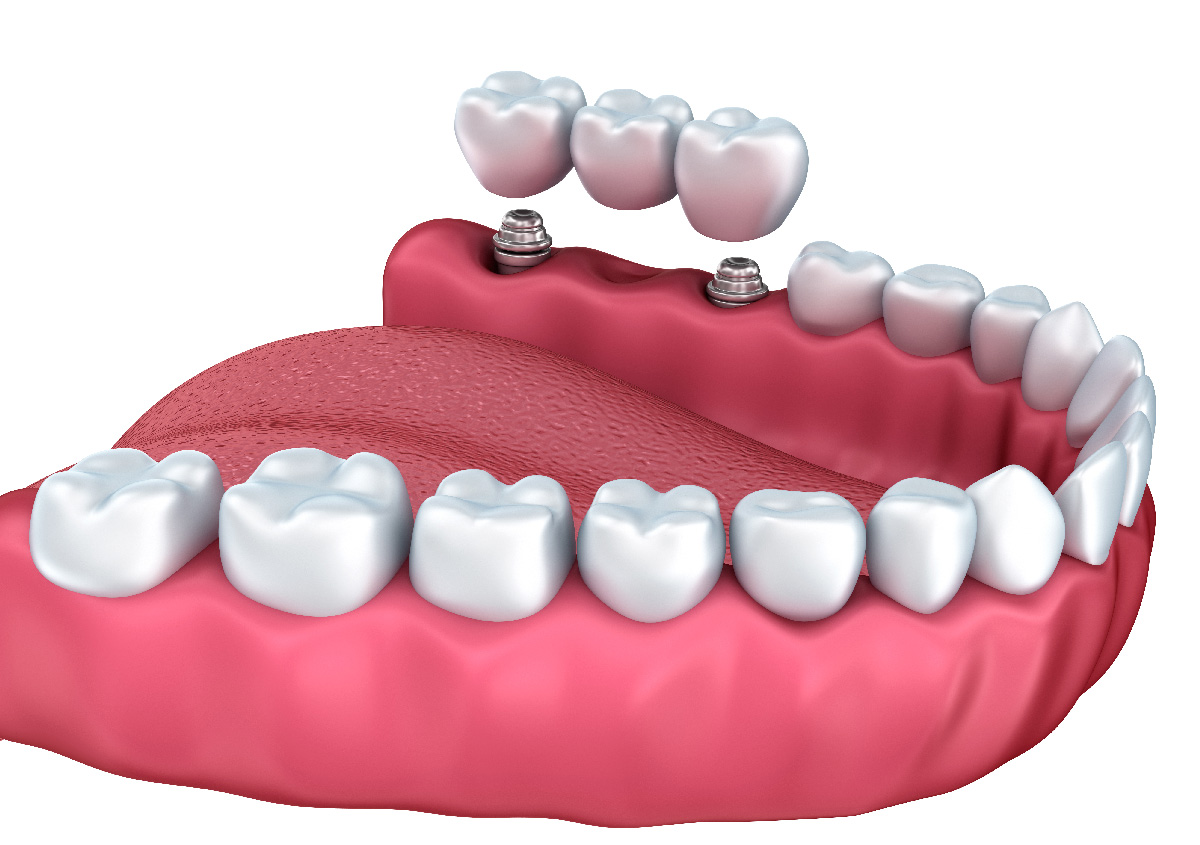
There are two ways to replace teeth as long as other teeth remain in the same arch. The most stable replacement is the fixed partial denture, or bridge. A bridge uses crowns as the anchors on the remaining stable teeth on either side of the space, with the replacement tooth or pontic being attached to these anchors. The bridge is cemented to the anchor teeth. When properly executed, a bridge feels very similar to natural teeth. The anchor teeth provide the normal tactile sensation to the entire prosthesis. The new bridge provides the maximum stability for the entire occlusion and is able to accommodate occlusal forces approaching those for natural teeth.

Bridges are generally made of porcelain-fused-to-metal crowns or are all gold or gold alloy. All-porcelain bridges generally do not have the strength to stand up to heavy occlusal forces. The other option for tooth replacement when some teeth are remaining is the removable partial denture, what some people call a partial plate or a partial denture. This type of prosthesis uses some of the remaining natural teeth as anchors but is removable. The partial denture will restore chewing function and stability but not to the degree of a fixed bridge. Sometimes the removable partial denture is the only alternative for a person if there are not enough stable teeth to support a bridge. While a removable partial denture can provide suitable service, it must be evaluated periodically. Over time, the residual jawbone may continue to resorb, changing the underlying support for the partial denture. Subsequently, more force may be placed on the anchor teeth, loosening them. Also, contrary to what you might expect, the anchor teeth for partials are more difficult to keep clean. This makes them more susceptible to caries or periodontal disease.

Today anyone can have a beautiful smile. Your smile is our first priority, and we will give you reasons to smile. To schedule an appointment with a Sacramento dentist, Kosta J. Adams please call (916) 927-0800 today.

Sacramento Dentist: Adams Kosta J DDS
2 Scripps Drive
Sacramento, CA 95825-6207
(916) 927-0800

Share

Repairing Decayed Primary Teeth

Primary teeth can and do occasionally become decayed. It is important that a decayed primary tooth is repaired. Leaving the decay untreated may lead to toothache, abscess, or tooth loss. An infected primary tooth may damage the permanent tooth underneath it. The premature loss of a deciduous tooth may cause the other teeth to move, thereby reducing the space available where the permanent teeth erupt. This may eventually result in expensive orthodontic treatment which could have been avoided with some inexpensive treatment earlier.

Primary teeth with small cavities may be restored with amalgam or composite resin. For primary molars with large areas of decay, the treatment of choice may be to remove the pulp tissue by doing a pulpotomy, then placing a medicated filling and a stainless steel crown over the tooth. Anterior teeth may be treated with either stainless steel crowns or with tooth-colored plastic crowns.

The restored tooth is then functional and space-holding, and may contribute to aesthetic appeal until it is naturally lost. These appliances, sometimes as simple as a wire loop soldered to an orthodontic band which is then cemented onto a remaining molar, will maintain the appropriate space so that the permanent succedaneous tooth has space to erupt.

Today anyone can have a beautiful smile. Your smile is our first priority, and we will give you reasons to smile. To schedule an appointment with a Sacramento cosmetic dentist, Kosta J. Adams please call (916) 927-0800 today.

Sacramento Dentist: Adams Kosta J DDS
2 Scripps Drive
Sacramento, CA 95825-6207
(916) 927-0800

Share

Root Canals

Sometimes the decay has progressed to the point where it gets close to or reaches into the pulp in the center of the tooth. This encroachment may manifest itself as a toothache. If the decay is removed and the pulp has not been physically entered with the dentist’s drill, the tooth may be fixed with a conventional restoration. If the decay extends into the pulp, or if there is other evidence that the pulp is damaged or dead, endodontic (root canal) therapy is in order to preserve the tooth.

Root canal therapy involves entering the root canal system which is located in the center of the tooth root. The remaining pulp tissue and/or necrotic debris is removed with special instruments. In some cases, once the canal has been properly cleaned and shaped, the root canal filling material can be placed. This material is usually gutta percha, a type of rubber, which is compacted into the canal system and held in place with a sealer or cement.

If the pulp is necrotic or the tooth symptomatic (painful) or infected, it may take two or more visits for the endodontic treatment to be finished. The general rule of thumb is that there is one canal for each tooth root, but, as rules are made to be broken, often there is an accessory canal in a root. This sometimes presents a challenge because these accessory canals are hard to find and may be narrow, making it difficult to get instruments into the canal for proper cleansing. Once the canals are found, accessory canals are treated in the same way as the main ones.

Our fees are very competitive so give us a call. Today anyone can have a beautiful smile. Your smile is our first priority, and we will give you reasons to smile. To schedule an appointment with a Sacramento CA dentist, Kosta J. Adams please call (916) 927-0800 today.

Sacramento Dentist: Adams Kosta J DDS
2 Scripps Drive
Sacramento, CA 95825-6207
(916) 927-0800

Share

Paying for Dental Care

The financing of dental care is undergoing the same metamorphosis—some would say revolution—that is occurring in medicine. The three major ways of financing dental care are out-of-pocket (dentists call this fee-for-service), some type of dental insurance, and managed care or capitation. In the entire health care financing debate one overarching concept must be kept in mind: you get what you pay for, and in some cases a lot less than what you think you should get regarding your dental plan coverage.

Fee-for-Service - In this system, you, the patient, visit your local dentist. The dentist has specific charges for each service or procedure. The fee has to cover both the direct and indirect expenses incurred during the providing of that service. Direct expenses include the dentist’s time and expertise (which many patients forget about), as well as the cost of necessary supplies and materials. Supply costs have skyrocketed over the past few years, as infection control techniques have become significantly more extensive and sophisticated. Indirect expenses include staff salaries, utilities, rent, professional requirements such as license renewal and membership in professional associations, insurance, and other costs of doing business. Dentists set their fees so as to be compensated accordingly.

Our fees are very competitive so give us a call. Today anyone can have a beautiful smile. Your smile is our first priority, and we will give you reasons to smile. To schedule an appointment with a dentist Sacramento, Kosta J. Adams please call (916) 927-0800 today.

Sacramento Dentist: Adams Kosta J DDS
2 Scripps Drive
Sacramento, CA 95825-6207
(916) 927-0800

Share

The Dental Examination

The dentist in Sacramento CA should ask you why you have sought treatment. If there is an existing problem, be as comprehensive as possible in relating the location, symptoms, and duration of the problem. The dentist in Sacramento CA should conduct a complete extra oral and intraoral examination. This includes visual inspection of both the face and neck and palpation of these structures.

Beware of any new lumps, bumps, or discolorations in these areas. Once the extraoral examination is completed, a thorough intraoral examination is performed. Again, this includes visual and manual inspection of the intraoral soft tissues of the cheeks, tongue, floor of the mouth, and oropharynx (back of the throat).

A dental explorer—a sharp, pointed instrument placed into the crevices of the teeth—is used to look for the presence of caries. A sticky spot on a tooth may indicate the presence of caries or a deep groove.

A transilluminator—a small fiber-optic light wand—may be useful in detecting caries between the teeth. Existing fillings and crowns must also be checked for defects or recurrent decay around the margins of the restorations.

Today anyone can have a beautiful smile. Your smile is our first priority, and we will give you reasons to smile. To schedule an appointment with a dentist in Sacramento CA, Kosta J. Adams please call (916) 927-0800 today.

Sacramento Dentist: Adams Kosta J DDS
2 Scripps Drive
Sacramento, CA 95825-6207
(916) 927-0800

Share

Other Oral Hygiene Aids – Mouth Rinses

Mouth rinses may also be helpful in maintaining your oral health, but only if you pick the right one. Many mouth rinses can freshen the breath; only two major classifications have demonstrated effectiveness in reducing both plaque and gingival inflammation.

The first group of mouth rinses contains the detergent chlorhexidine. Chlorhexidine is found in some surgical soaps. In small concentrations, 0.12% in the United States, chlorhexidine has been shown to reduce both plaque and gingivitis over a 6-month period. These are marketed as Peridex® by Procter & Gamble and Periogard® by Colgate. Both are available only by prescription.

Chlorhexidine rinses have 3 possible side effects. In many cases, a brownish stain may appear on the teeth, tongue, and tooth-colored composite resin fillings. While the stain is easily removed from enamel, stained roots and composites are much more difficult to clean. You may brush your tongue immediately after expectorating the mouth rinse. Some people have also reported a transient change in taste while using the mouth rinse.

Today anyone can have a beautiful smile. Your smile is our first priority, and we will give you reasons to smile. To schedule an appointment with a dentist in Sacramento, Kosta J. Adams please call (916) 927-0800 today.

Sacramento Dentist: Adams Kosta J DDS
2 Scripps Drive
Sacramento, CA 95825-6207
(916) 927-0800

Share

Fluoride Gel/Toothpastes

Fluoride Gel

If you have a lot of cavities or fillings in your mouth, your dentist may recommend that you use a fluoride gel as part of your oral hygiene regimen. This gel may be applied after brushing and interproximal cleaning. It is usually left on the teeth for one minute and then expectorated. Stannous fluoride is the home fluoride gel most often used both for the control of caries and for tooth sensitivity. Patients with porcelain crowns or composite resin (plastic) fillings should use a neutral sodium fluoride gel, as the stannous fluoride may damage the surface of the restoration.


Toothpastes

Toothpastes come in seemingly countless varieties. The basic rule of thumb is to use a fluoride-containing toothpaste with the American Dental Association’s Council on Dental Therapeutics Accepted Seal on the label. This seal reads in part ” (name of product) has been shown to be an effective decay-preventive dentifrice that can be of significant value when used as directed in a conscientiously applied program of oral hygiene and regular professional care.” There are many specialty toothpastes on the market for tooth whitening. Pick one that contains fluoride if you wish to use these products.

Your smile is our first priority, and we will give you reasons to smile. To schedule an appointment with a Sacramento dentist Kosta J. Adams please call (916) 927-0800 today.

Sacramento Dentist: Adams Kosta J DDS
2 Scripps Drive
Sacramento, CA 95825-6207
(916) 927-0800

Share

Flossing

Brushing is not effective in cleaning the side surfaces of the teeth. For patients without any recession, dental floss is the weapon of choice. The floss is used to wipe the surfaces of the teeth clean of plaque, not just to remove food from between the teeth. About a 3-foot piece of floss should be used for each session. This may seem like a lot until you realize that it costs about 2 cents per piece. Most of the floss should be wrapped loosely around your left middle finger, with a little wrapped around your right middle finger. In this way, as the floss is used, it is taken up on the right finger and unraveled from the left, providing a clean section of floss.

Using the middle fingers to hold the floss means that your index fingers and thumbs are free to manipulate the floss as needed. People who wrap the floss around their index fingers then have great difficulty getting the floss where they want it. The floss is used to clean the side surfaces of the tooth, both above and below the gum line, which the toothbrush cannot reach.

Your smile is our first priority, and we will give you reasons to smile. To schedule an appointment with a Sacramento dentist Kosta J. Adams please call (916) 927-0800 today.

Share

Electric Toothbrushes

For those who have difficulty handling a manual brush, or who like to have the latest equipment, there are several electric toothbrushes on the market. It is generally agreed that, all else being equal, powered toothbrushes are more effective than manual ones; however, keep in mind that it is possible to maintain optimal oral health with a manual brush and floss. There is no consensus yet as to which powered brush is best.

The advantages of a powered brush include the availability of different motions in the bristles, and also wider handles, which can be managed by people with arthritis or other dexterity problems. The disadvantages include cost, bulkiness, and the possibility of the motors or charging systems breaking down or wearing out. As with manual toothbrushes, a brush with a small head will allow easier access to hard-to-reach places. It is critical that the bristles be properly angled toward the tooth surfaces, or these brushes will not be of any use at all.

In any event, read the directions when you purchase a new brush; proper maintenance will significantly extend its life.

Your smile is our first priority, and we will give you reasons to smile. To schedule an appointment with a Sacramento dentist Kosta J. Adams please call (916) 927-0800 today.

Share

Decay Prevention

Fluoride helps to slow or prevent the decay process by making the enamel less susceptible to acid dissolution. Fluoride is often added to municipal drinking water supplies, and is found in some toothpastes. Even in this era of prevention, approximately 40% of the nation’s drinking water is not fluoridated. There is no epidemiological evidence to suggest that fluoride at i part per million (ppm) is in any way a health hazard. To be sure, higher concentrations of fluoride, greater than 5 ppm, maycause changes in developing enamel surfaces and extremely high concentrations may be fatal. In addition to the passive use of fluoride in the drinking water, the best way for you to prevent caries is to effectively remove plaque from your mouth on a daily basis. Interproximal cleaning is as important as smooth surface cleaning. Many cavities start in the contact area between two teeth.

Another factor in caries prevention is the amount and frequency of intake of sugary foods. After eating, the pH, a measure of acidity, decreases around teeth for approximately 20 minutes. A lower pH means greater acid production. This lower pH is eventually raised by the bathing and buffering action of saliva. The sooner you eat, the sooner the pH decreases again. This cycle continues until the decay process starts. One option is to always brush immediately after eating or after drinking sugared beverages. When this is not possible, at least rinse thoroughly with water to decrease the amount of residual sugar in your mouth.

To schedule an appointment with a Sacramento dentist Kosta J. Adams please call (916) 927-0800 today.

Another method of caries reduction is the use of sealants in the posterior teeth. Sealants are a type of composite resin plastic which is bonded to the chewing surfaces of the molars, as a wood floor would be sealed with polyurethane to protect the wood. The sealant will keep decay from gaining a foothold in the grooves of the molar chewing surface. Sealants are recommended for teeth with deep grooves which are difficult to keep clean. Molars with shallow grooves probably do not need sealants. Teeth which have been in the mouth for several years with no evidence of decay also do not need to be sealed.

To schedule an appointment with a Sacramento dentist Kosta J. Adams please call (916) 927-0800 today.

There are several habits which are detrimental to healthy teeth. Eating sweetened foods, drinking sugared soft drinks, and chewing sugared gum all contribute to the metabolism of the plaque on your teeth. There is some evidence to suggest that chewing sugarless gum may decrease the incidence of caries. For one thing, the sweeteners in these gums cannot.

To schedule an appointment with a Sacramento dentist Kosta J. Adams please call (916) 927-0800 today.

Share